Is „From the river to the sea“ antisemitic?

When it comes to demonizing the Palestinian cause and defaming pro Palestinian protestors, often the slogan „from the river to the sea, Palestine will be free“ is referred to, supposedly as the ultimate proof that Palestinians and their supporters are calling for nothing short of another holocaust to exterminate Israel and the Jews.

This is wrong, dishonest and framing in a manner to portray (Pro) Palestians as genocidal racists.

First of all, the slogan is from the 1960s and predates Hamas by decades.

Most people are unaware that Israeli politicians and Israels greatest party Likud have been laying claim to the same „river to the sea“ area, albeit entirely for Israel?
a) The 1977 election manifesto of the right-wing Israeli Likud party said „between the Sea and the Jordan there will only be Israeli sovereignty.“
b) During a speech before the United Nations General Assembly on September 22, 2023, Prime Minister Benjamin Netanyahu holds up a map that shows Israel stretching “from the river to the sea.”, basically removing any space for a Palestinian state.

The same statement, expressed by Israelis – up to the level of the Prime Minister – raises no concern and alarm among the pro Israeli audience that sharply condemns the statement when uttered by Palestinians. It is a blatantly racist point of view to accuse one side of genocidal intentions but do not object to the other side.

Furthermore, at face value the phrase does not say whether it´s calling for the liberation of Palestine from Israeli occupation or for the destruction of the state of Israel.

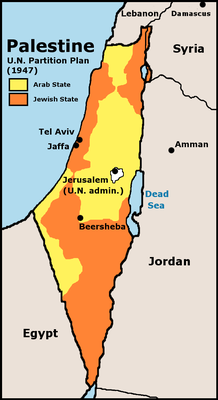
Looking at the map of the original UN division plan, the „Arab state“ (commonly understood as the Palestinian state) would indeed reach from the (Mediterraen) sea to the (Jordan) river:
https://www.ieg-ego.eu/illustrationen/entiwcklung-des-zionismus-bilderordner/karte-un-teilungsplan-fuer-palestina-img/@@images/107a5790-2927-4043-8a92-4d7077016da7.png

The slogan, however does not state that the entire east coast of the Mediterrean and the entire west bank of the Jordan river shall belong to Palestine and completely exclude Israel.

Aside rejecting the allegedly genocidal meaning and intent of the slogan, two Jewish Professors have another interesting take:
„if we accept that a Palestinian calling for the ‘liberation of Palestine from the Jordan River to the Mediterranean sea’ wants to expel the Jews from Israel, then fairness requires that the opposite should also hold true: that anyone who has ever supported Greater Israel – from the poet Nathan Alterman (one of the most important Israeli poets, who identified politically with the Labour party) and the signatories of the Greater Israel Manifesto in 1967 to the current government and the public that supported it at the ballot box – actually supports the annihilation or expulsion of the Palestinians.

But this too would be inaccurate…“

The authors argue that both „from the river to the sea“ and „Palestine will be free“ have a variety of meanings and a wide range of interpretations, e.g. „Even if a significant portion of Palestinians are willing in principle to agree on a compromise that would mean the establishment of a sovereign Palestinian state in the West Bank, East Jerusalem and the Gaza Strip, which together constitute about 22% of Mandatory Palestine, they still regard all of Palestine as their homeland.“

They also refer to the fact that „it should be mentioned that the 2017 addendum to the [1988 Hamas] charter (par. 20) accepts the idea of a Palestinian state along the 4 June 1967 borders (i.e. the borders prior to the 1967 war) as a ‘formula of national consensus’.“

Another Middle Eastern scholar writes „the majority of Palestinians who use this phrase do so because they believe that, in 10 short words, it sums up their personal ties, their national rights and their vision for the land they call Palestine.“
The phrase „also seeks to reaffirm Palestinians’ national rights over their homeland and a desire for a unified Palestine to form the basis of an independent state.“

The Palestinian-American writer Yousef Munayyer says the phrase is „merely a way to express a desire for a state in which “Palestinians can live in their homeland as free and equal citizens, neither dominated by others nor dominating them”.“

The German journalist Kristin Helberg legitimately refers to two less biased and less violent interpretations of the slogan: „Either it is about bringing an end to the occupation of the territories that have been occupied since 1967, and establishing a Palestinian state alongside Israel. Or the aim is a one-state solution, which affords equal rights to all residents. In light of the seven million Jews and seven million non-Jews living in the territory, this could, in the medium term, turn Israel from a Jewish state into a state for all citizens. In neither case is anyone saying that Jews should be expelled or even murdered. „


The IDF´s perfidious public deception strategy

Politically interested individuals following the Near East conflict surely have heard of the Israeli „Defence“ Forces (IDF) calling itself the „most moral army“ in the world.
This arrogant act of self-praise has often been uncritically repeated by Israelis and non-Israelis likewise.

In this context, the IDF has at times been forced to make great efforts to conceal acts and statements that were in clear contradiction to the self-given label that is otherwise impossible to prove objectively.

To achieve this, the IDF has resorted to a matrix of reactions that can be summatized as a public deception strategy with the aim to exonerate the IDF from obvious crimes it has been accused of.

The matrix consists of following elements:
deny and reject (the war crime or atrocity)
distract (by bringing up unrelated issues)
defame (the victims) and belittle the crime
delay the eventual confession of truth until public attention has dimished or has been diverted

Some better known examples:
The Qana massacre in Lebanon, 1996 – 106 civilians were killed when the IDF shelled a compound, a UN battalion headquarters for 18 years, well-marked on Israeli maps, and bearing white and black UN signs.
When confronted with having had knowledge of the location of the compound and the presence of civilians, the IDF first denied the reconaissance drone that it had operated and then distracted from it´s role by claiming it was on a different mission.
Here´s a link about the UN findings:
https://www.nytimes.com/1996/05/08/world/un-report-suggests-israeli-attack-was-not-a-mistake.html

Killing civilians- During the 2018 „Great March of Return“ IDF snipers killed and injured thousands of Palestinians, mostly civilians, from behind the security fence; „including 1,849 children, 424 women, 115 paramedics and 115 journalists
„The nature of these injuries shows that Israeli soldiers are using high-velocity military weapons designed to cause maximum harm to Palestinian protesters who do not pose an imminent threat to them.“
One of the victims, „21-year-old Razan al-Najjar, Palestinian paramedic, was shot in the chest and killed by Israeli sniper fire while providing first aid to injured protesters at the Gaza/Israel fence east of Khan Younis, in southern Gaza. Razan was wearing her white coat, clearly identifiable as a medic.“
Here, the IDF resorted to the distract, defame and belittle strategies: Victims were recklessly called Hamas members or sympathisizers, while the protests were called „border riots“ and the killings were named „clashes

The killing of Al Jazeera journalist and US citizen Shireen Abu Akhleh
Time magazine wrote, that short after the news of the journalists killing was spread, Israeli authorities „decided to circulate a video of a Palestinian gunmen shooting indiscriminately from inside the Jenin refugee camp and blame them for the Al Jazeera reporter’s death. But its strategy fell flat when another video revealed that Abu Akleh died nowhere near there.“
A monthlong investigation by The New York Times found that the bullet that killed Ms. Abu Akleh had been fired from the approximate location of an Israeli military convoy earlier that morning, most likely by a soldier from an elite unit, corroborating witness reports from the site.
The Guardian reported that Israel announced to not cooperate with the FBI.
Finally, 4 months later in September 2022, Israel concluded it is ‘highly possible’ one of its soldiers killed Shireen Abu Akleh.

Targeted (intentional) killing of foreign aid workers
The most recent case and a particularly ruthless and shameless one was the attack on the convoy of World Central Kitchen. While Israel tried to deny having attacked the convoy deliberately, it turned out that 7 WCK workers had been killed when three cars of their convoy were each hit by Israeli missiles over a distance of 2.5 Km.
„Two of the SUVs traveling Monday were armored and bore the frying pan logo on the roof“.

When the Israeli military killed a 12 year old boy, Muhammad Al-Durrah next to his horrified and badly wounded father, Israeli officials claimed the film by France 2 channel showing the killing of the boy was staged.
As with many similar cases, the Israeli denials and fake allegations were dishonest and spin themselves according to The Guardian.

In many instances, the western press played the inglorious role of casting doubt over Israeli crimes („supposedly attacked…“) and shielding Israel by little credible claims like „Israeli authorities are investigating the allegations“, as if past investigations ever led to serious repercussions for Israeli perpetrators of atrocities and human rights abuses.

When Muslims rescued Jews…

A person is either your brother in faith, or your equal in humanity
                                                                   (Ali ibn Abi Taleb, cousin and son in law of Prophet Muhammad)


Many observers of the current negative peak of the decade long Middle East conflict, both pro Israelis and pro Palestinians think that the nature of the hostilities is religious. They think that the relationship between Muslims and Jews was historically marked by animosity, driven by sectarian hatred. Except that this is a regrettable misconception.

This article will strive to counter this common prejudice by highlighting some widely unknown and probably unexpected cases of Muslim people helping and in fact rescuing Jewish people.

  1. Albania, where the Pilkus, a Muslim family, harbored young Johanna Neumann and her mother in their home during the German occupation and convinced others that the two were family members visiting from Germany. “They put their lives on the line to save us,” Neumann, now 86, told TIME on Friday. “If it had come out that we were Jews, the whole family would have been killed.”
  2. Iran: Abdol Hossein Sardari, an Iranian diplomat in Paris during World War II, successfully convinced Nazi German authorities to exempt Iranian and other Caucasian and Central Asian Jews residing in the occupied zone from anti-Jewish measures.
  3. Iran: Despite the Iranian people suffering from the 1942-1943 famine, Iran became a place of refuge for 116,000 Polish refugees, of whom, around 5,000 were Polish Jews. The Jewish children would come to be known as the Tehran Children.
  4. Tunisia, where Khaled Abdul-Wahab, the „Arab Schindler“ saved 25 Tunisian Jews from the Nazis during the Holocaust.
  5. Bosnia: When the Jewish Kavilio family, fleeing the German invasion of Yugoslavia, found themselves without a home, the Hardaga family, observant Muslims, provided shelter and considered the Kavilios part of their family. “Our home is your home”, they said, and to demonstrate this point, the women were not obliged to cover their faces in the presence of Josef Kavilio, since he was now a member of the family.
  6. France: During the Nazi occupation of France frightened Jews fled to The Grand Mosque of Paris where they were sheltered and given Moroccan passports prior to being smuggled out of Paris to safety.
  7. Morocco: Young Sultan Mohammed V declined to assist in the persecution of Jewish citizens. “I reiterate as I did in the past that the Jews are under my protection and I reject any distinction that should be made amongst my people.”
  8. Turkey: Selahattin Ulkumen, the Turkish consul-general on the island of Rhodes which was under German occuaption managed to save approximately 50 Jews in July 1944.
  9. Ottoman empire: When the spanish inquisition resulted in the expulsion of Jews from Spain and Portugal in 1492, Sultan Beyazid II welcomed Sephardic Jews and allowed them to settle in various cities. He sent out proclamations throughout the empire that the refugees were to be welcomed.
  10. (Nazi) Germany: When the deportations of the Jews from Berlin began, and Anna Boros, a family friend, was in need of a hiding place, Egyptian Dr. Mohammed Helmy brought her to a cabin he owned in Berlin, which became her safe haven until the end of the war. He was recognized by Israel as one of the Righteous Among the Nations in 2013, with his name being listed at Yad Vashem in the city of Jerusalem.

Weiterlesen

Norouz and Islam (or religion)

I have heard people debating whether Islam and Norouz are „compatible“.

Here are my thoughts:

First of all, Norouz is a national celebration of all Iranians independent of ethnicity, dialect or religious belief while Islam is one among several religions.
From a rational point of view there is no „either, or…“ to decide about.
You can be atheist, Zoroastrian, Muslim, Bahai..and celebrate Norouz.

In case of Islam, no matter whether you are a practising pious Muslim or a mainstream Musim there is no reason to not celebrate Norouz. This is because Norouz does not violate any islamic principles. It does not hinder anyone from believing in God, prophet Muhammad or the herafter.

Contrary to a wide spread but wrong understanding of piety Islam is not hostile to being happy or celebrating. Islam does not demand from a Muslim to do nothing else than praying or fasting or reading Quran.

Some calls for banning Norouz because it allegedly contradicts Islam are as absurd as banning TV programs or sports because these activities supposedly distract people from performing their „religious duties“.
This is of course complete nonsense. Norouz´ entire duration is 13 days and even during that period anyone can pray or fast or read Quran as much as he likes.

Religious zealots must be cautious not to alienate people against religion by unnecessary and out of perspective radicalism. They are doing a disservice to religion by placing and portraying it as an antipole to everything that people love.
Don´t blame religion. Blame (some) religious people.

The bizarre „terrorist“ policy of the US

The relationship of the US with and her attitude towards the Taliban is marked by irrationality and inconsistencies.

In the 1990s when Iran backed and supported the Afghan „Northern Alliance“ in their fight against the Taliban, the United States took no anti-Taliban position.
While the Taliban took Kabul in 1996 and went on steadily gaining ground against their adversaries American Petroleum companies secretly met Taliban delegations and US envoy Zalmay Khalilzad downplayed the radicalism of the Taliban.
Northern Alliance´ military commander Ahmad Shah Massoud sought American and European support but got none with only Russia, Iran and India funding and arming his faction. The Taliban, however, received massive man power, monetary and weapons support from Pakistan and Saudi Arabia, both US allies in the region.

In the aftermath of 9/11 The US invaded Afghanistan and drove the Taliban from power, but the Taliban proved to be resurgent. The central governments power never really extended much outside of Kabul. Many areas remain contested and insecure today. 18 years after their „defeat“ the Taliban manage to overrun bases of Afghan special forces or to launch attacks inside Kabul inflicting huge casualties.

It can be rightfully concluded that the US „war on terror“ conducted in Afghanistan since almost two decades continues to be a huge failure, despite having stationed between 15.000 and 130.000 Nato troops there, in addition to more than 300.000 Afghan army soldiers being trained for many years.

Paradoxically the US has blamed Iran for the ongoing debacle in Afghanistan claiming that Iran has been supporting the Taliban. Needless to say that there is no proof for such claims: No Iranian weapons convoys being sighted going from Iran to Taliban areas, no Iranian cargo planes landing in secret Taliban air bases. Nothing. Plus, the Talibans traditional strongholds are far away from the Iranian border and both on the border to and inside of Pakistan, a US ally.

Interesingly some American officials have blamed Iran for holding talks with the Taliban, but at the same time considering it very natural that the US is doing the same very officially.

This grotesque attitude towards the Taliban and the obvious double standard of condemning others for negotiating with an „evil force“ while considering it normal and justified to do it when it serves US interests is in line with American foreign policy elsewhere:

The US has no problem with Israel openly admitting having supported Al Qaeda elements in Syria (Video minute 2:40 and 3:58) and „defends“ Al Qaeda versus Hizbollah by stating that Al Qaeda has not attacked Israel.

The US is also not much bothered by it´s allies Saudi Arabia and the United Arab Emirates equipping Al Qaeda elements in Yemen with American weapons. These Al Qaeda elements do not any longer fight the „Arab coalition“ but the Houthi rebels.

The same went on for years in Syria where Saudi Arabia and other US allied GCC countries massively supported Syrian insurgent groups affiliated with Al Qaeda.
Al Qaeda aligned insurgent forces in Syria probably field well over 20.000 fighters, most of them located in the North Western province of Idlib, yet in 4.5 years of military presence in Syria the US airforce hardly ever attacked Al Qaeda. Instead it bombed and killed hundreds of Syrian, Iraqi and even Iranian fighters engaged in fighting Isis in Eastern Syria.

Apparently Al Qaedas sectarianism and terror is only bad when it hits the US, but when Iran, Syria or Russia are affected by Al Qaedas violence the US and it´s partners overtly and/or covertly support Al Qaeda.


Western regret over not having supported Syrian rebels in 2011 is silly

As early as in 2012 when even official western reporting increasingly conceded that sectarian jihadists had „hijacked“ the Syrian „revolution“ many „experts“ expressed regret over the earlier non-intervention of western military powers in favor of the Syrian rebels.

The implicit argument that before it´s radicalization the „uprising“ deserved western support is flawed in many instances:

1. Despite often repeated but misleading claims about the „revolution“ having been peaceful „at least for 6 months“ (or one year according to others)  it was always disputed whether not major parts of the uprising were armed, violent and sectarian from the very beginning. Contrary to the former romanticization of the insurgency deadly attacks and systematic ambushes on police and army happened from day one.

2. After the Libya experience it was clear that Russia would not accept a UN resolution allowing western states to go for their much desired „regime change“ under the pretext of „responsibility to protect“.

3. There was never a Syrian opposition with a broad popular support base inside of the country. After the experience with Ahmad Chalabi in Iraq probably even western regime change proponents were suspicious of similar claims by Syrian exile opposition members.

4. There was no truly deployable opposition ground force to bank on. The „Free Syrian Army“ never had any command and control structure, cohesion, unified leadership or infrastructure. It was never more than a name, but a disconnected conglomeration of undisciplined local militias. By contrast, in all the year when various rebel factions tore eachother apart and entered coalitions even with Isis and Al Qaeda (Al Nusrah) just to abandon them or be abandoned, fought and disarmed by former allies, the Syrian army and it´s allies never had any internal fighting.

5. Why should external powers intervene in a civil war, bring about the defeat of the stronger side and empower forces that they don´t know and whose actions they probably cannot predict and contain?

It is very likely that despite much rhetoric about supposedly regretting the lack of earlier action on behalf of the Syrian rebels and against the Syrian government, the army leaderships and secret services of the western powers had serious and legitimate concerns about bringing to power sectarian and highly violent radicals.

Dubious source: „Violations Documentation Center“ (VDC)

Many reports about the war in Syria frequently quote the „Violations Documentation Center“ (VDC), however the information released by the VDC must be treated with much skepticism.

Here some reasons why:

1.
„This source is highly partisan. For example they divide fatalities into two overall groups: “Martyrs” and “Regime Fatalities”.

Martyrs” include ISIS fighters and foreign mercenaries killed by the Syrian Army/Militia or even by the U.S. airstrikes around Kobani. See the VDC screenshot photo 1 showing the ISIS “martyr” killed in Kobani. Photo 2 shows a young girl listed as “regime fatality”…There is little or no evidence provided regarding most of the alleged victims. Photographs and video evidence is provided for a small minority of the cases.“
https://www.counterpunch.org/2015/05/14/eight-problems-with-amnestys-report-on-aleppo-syria/

2.
„there are good reasons to believe the VDC is listing dead insurgents as civilians, as well as mislabeling dead government soldiers as FSA fighters.”

One example he cited was the listing of a Jaysh al-Islam militant, ‘Hisham Al-Sheikh Bakri’, killed by the SAA in Douma (infested with Jaysh al-Islam terrorists), in February 2015, which al-Masdar News reported. The VDC also listed ‘Hisham Abd al-Aziz al-Shaikh Bakri’, “however this one is listed as an adult male civilian and not a Jaish Al-Islam fighter,”
https://steigan.no/2015/10/deconstructing-the-nato-narrative-on-syria/

3.
If you go to the VDC site and check for adult male civilian deaths it shows (Feb. 16th, 2018) 79.254 deaths, while the total number of civilian deaths is shown as 111.803. So, almost 71% of all civilian deaths are adult males, while we have been hearing that most civilian victims (of course almost all killed by „the regime“) are women, children and elderly…Why is the percentage of adult males so high? Can it be that a sizable portion were NOT civilians?
http://www.vdc-sy.info/index.php/en/martyrs


Why is Iran supporting Hezbollah?

Many Iranians are complaining about Iran helping Hezbollah in Lebanon, often emphasizing that there are enough poor and needy people in Iran more worthy of support.

While it´s true that there are indeed many poor people in Iran, we should keep in mind that Irans financial problems are not due to money „wasted“ on funding Hezbollah but mainly to – largely unjustified –  western sanctions. Irans loss from being disconnected from the international payment system and from the extreme sanction based decline of foreign direct investments is in the tens of Billions.

Hezbollah is Irans extended front line with Israel. Without this „artificial border“ Iran would not be able to deter Israel from attacking Iranian facilities by making use of US provided long range bombers.

Thus, when the civil war in Syria broke out and took a clearly sectarian tone by attracting foreign Shia- and Iran-hating Jihadists, both Iran and Hezbollah understood the existential threat. It was no coincidence that Israel immediately supported the „rebellion“ in Syria (while at the same time treating stonethrowing Palestinian youth as „terrorists“).
Irans support for the Syrian government is neither because of the former being led by an Alawite (often wrongly called a „Shia sect“) nor with the purpose of expanding Shia Islam or suppressing Sunnis. If Irans motivations were „sectarian“ then why did the country support Sunni Afghans (Massouds Northern Alliance) and Arabs (Hamas)? Why the support for Sunni Europeans (Bosnians) in the Balcan wars?
Irans support for Syria has three main reasons:
1. During the Iran-Iraq war Syria supported Iran, while all Arab middle east and Gulf states supported Iraq with money and arms, sometimes even with fighters.
2. Syria shares a border with Israel and constitutes another remote front line for Iran in case of a war with Israel.
3. Syria is the only land route to Southern Lebanon. Without an Iran friendly government in Damascus Hezbollah would not last long in any conflict.

The departure of the Syrian army from Lebanon in 2005 marked the rise of Salafi militants in that country. These forces have at times not only attacked Hezbollah but also engaged the Lebanese army.
As early as in the first months of the start of the Syrian war Salafi militants from Lebanon were intruding Syria and attacking the police and armed forces.

Iranian military strategists recognized the threat immediately: A sectarian insurgency enjoying the support of western powers, Israel, Turkey and the Gulf States, getting arms, funds, equipment and training from Saudi Arabia, Qatar, Turkey and the CIA while being romanticized and whitewashed by western and arab mainstream media would overpower the Syrian government. It was only a question of time.

As predictable as the pending fall of the Syrian ally was, it was also clear that the various backers of the insurgency shared one motivation: hatred of Iran and – as far as the Gulf states were concerned  – the Shia.
Iran could not afford to wait and see waves of foreign Jihadis arrive in Syria to not only „liberate“ the country from the „Nusayri infidels“ (derogatory term for Alawites) but in a further step move on to defeat the „Rafidhi“ (derogatory term for Shias) Hezbollah nearby in Lebanon.

What would happen next?
Since 2003 Iraq has been experiencing years of relentless bombings and massacres against the Shia majority (mostly civilians and including Sunnis living among Shias) carried out by radical islamists, many of them Arabs from Gulf countries. To make things worse Al Qaeda in Iraq (AQI), presumed dead, resurfaced as ISIS and intensified devastating terror attacks and warfare both in Syria and Iraq.
It was not far fetched to assume that after defeating the Syrian army and Hezbollah Syrias sectarian insurgency  would export the emerging „caliphate“ to Iraq to fight and defeat the Shia government. Despite the Shia making up some 70-75% of the Arab Iraqis the fall of the formally Sunni Saddam government was a thorn in Saudi Arabias eyes and continues to be hardly acceptable even 14 years later.

Iran had and has no interest in having hordes of sectarian „Majoos“ (derogatory term for Iranians used by Arabs) hating islamists on its borders. The decision to dispatch Hezbollah to the Syrian battlefields was nothing but the correct anticipation of an upcoming deadly menace to Irans security and territorial integrity.
In Syria Hezbollah continues to suffer casualties but has managed to contribute heavily to the survival of the government and the rolling back of the jihadists. Hezbollah engaged and defeated both Al Qaeda and Isis in Lebanon as well as on Syrian battle fronts. Without Hezbollah fighting Isis near the Iraqi border in eastern Syria the Iraqi army would have a much harder time defeating Isis in Mossul.

Hezbollahs proven capabilities in assymetrical warfare are a major reason why so far Israel has refrained from attacking Iran.
Plus, as mentioned, Hezbollah managed to severely weaken the anti-Iranian, predominantly Salafi insurgency in Syria and choke off any domino effects leading to the reestablishment of an anti-Iranian government in Iraq.

Rashideen convoy (Fua and Kafraya evacuees) bombing – another angle

After the suicide truck bombing of a convoy of waiting buses full of residents from Fua and Kafraya in the rebel-held western Aleppo suburb/outskirt of Rashideen, western mass media hurried to ignore some facts and twist and obfuscate others in order to deflect the rightful blame from the mostly Al Qaeda affiliated rebels.

One „fact“ which was not one according to veteran war reporter and Middle East conflict expert Elijah Magnier was the rebel claim reported and spread by BBC that the suicide vehicle could not have entered Rashideen without (Syrian) government permission, implying that the government (that – unlike the rebels – has never used suicide bombs as weapon) bombed the pro-government victims. In fact, however, the truck driver who blew himself up did NOT come from the government direction AND it is impossible he could have entered that area without being checked by rebels or having at least passed their checkpoints.

Another „proof“ for the rebels innocence was the oppositions pointing to the circumstance that some rebels guarding the convoy died as well.
Assuming this to be true, it does neither prove the rebels innocence nor the governments guilt, however, it clearly shows that the rebels consisting of so many different factions, even different degrees of radicalism within their most radical jihadi factions (former Al Nusra, now HTS; Ahrar al Sham, Jaish al Islam..) cannot control and contain their own forces and thus are highly unreliable as negotiation and deal partners.
While it is indeed very unlikely that Ahrar or al Nusra (HTS) killed their own fighters as deliberate „collateral damage“ of the massacre of Shia children, it is an absolutely realistic scenario that a 3rd party such as Jund al Aqsa, which could have disagreed with letting the „Shia apostates“ go decided to kill as many as possible Fua and Kafraya residents.

This latter aspect of the terror attack is something the almost entirely anti-Assad mass media choose to ignore, because it highlights a dilemma of Syrias opposition at which Assad and his government correctly point since years: There is no unified opposition with a clear, respected and powerful leadership. There is no opposition leadership that could negotiate with the Syrian government, give promises and have the capability to reliably control and enforce the implementation of the mutual agreement.
Why should the Syrian government attend negotiation meetings when the opposition participants are exiles who can exert no power on the field commanders and fighters involved in the daily fighting against the government?


Syrien: der Anschlag auf den Flüchtlingskonvoi

Bei dem Anschlag auf einen stehenden Konvoi von mehreren Bussen mit überwiegend schiitischen Flüchtlingen aus den Dörfern Fua und Kafraya in Syrien sind über 100 Menschen getötet worden, darunter ca. 70 Kinder.
Allem Anschein nach – hierfür sprechen sowohl Zeugenaussagen als auch mehrere Videos im Netz- wurde die Bombe durch eine sogenannte SVBIED (Suicidal vehicle borne intergrated explosive device) gezündet, eine von einem Selbstmordattentäter gefahrene mobile Sprengfalle.

Trotz der Umstände und der Identität der allermeisten Opfer berichten die Mainstreammedien systematisch irreführend: Die religiöse Zugehörigkeit der Opfer so wie ihre Loyalität wird nicht erwähnt, und es wird so getan als ob die Frage der Urheberschaft für den Terroranschlag nicht geklärt werden könne, weil sich doch keiner dazu bekannt habe.

Dass islamistische Rebellen – unklar welcher Fraktion – dahinterstecken ist jedoch mehr als eindeutig, wie man an folgenden Fakten bzw. Gegenfragen erkennen kann:
1. Die Opfer sind überwiegend Schiiten. Sie gelten speziell bei den salafistischen Rebellengruppen (Al Nusra Front bzw. inzwischen Hayat Tahrir al Sham, Ahrar al Sham oder Jaish al Islam) als Ungläubige bzw. Apostaten oder Häretiker.
2. Die Opfer sind loyal zur Regierung von Präsident Assad. Sie wurden seit Jahren in der von mehrheitlich islamistischen Rebellen kontrollierten Provinz Idlib belagert, ausgehungert und beschossen.
3. Autobomben so wie speziell SVBIEDs sind das häufigste und tödlichste Mittel der Rebellen. Die syrische Armee und ihre Verbündeten haben noch nie SVBIEDs eingesetzt.
4. Der Anschlag ereignete sich im von Rebellen kontrollierten Bezirk Rashideen westlich von Aleppo. Dort befinden sich weder Soldaten noch Milizionäre, die der Regierung angehören.
5. Bereits in Dezember hatten radikale Rebellen Busse, die für den Abtransport von Menschen aus den oben genannten Dörfern herbeigeschickt worden waren in Brand gesteckt und mindestens einen Fahrer getötet. Die Rebellen liessen sich triumphierend dabei filmen und sagten, dies sei Rache für Ostaleppo.
6. Auch jetzt gibt es Islamistenvideos in welchen Gewalt gegen die Schiiten aus Fua und Kafraya angekündigt wurde.

Jene dreisten Medien, die in ihrer schamlosen Verdrehung von Tatsachen versuchen, die Tat der Regierung Assad in die Schuhe zu schieben, sollen sich überlegen, wie sie überlegt und berichtet hätten, wenn eine „Fassbombe“ einen Konvoi von Sunniten aus der von Regierungstruppen belagerten Stadt Zabadani getroffen hätte:
Man hätte sofort und ohne jeden Zweifel „Assad“ beschuldigt, weil doch die Faktenlage „klar“ sei:
– Die Opfer waren Assad-Gegner
– Sie wurden im Assadgebiet getötet, wo Rebellen doch von aussen gar nicht Zugang hätten
– Die benutzte Waffe sei doch Assad-typisch

Eine weitere Unverschämtheit der Berichterstattung besteht darin, dass fast jeder Artikel 2-3 Rebellen- oder rebennahe Quellen zitiert und lediglich einmal Quellen, die loyal zur syrischen Regierung sind.
Es gibt auch keine 7 jährigen Banas oder andere perfekt in English twitternden Aktivisten, die zumindest neutral sind und von Ort und Stelle berichten.
Interessanterweise hat kein Medium Interesse gezeigt, die Überlebenden zu interviewen und hinsichtlich des Tathergangs und ihres Verdachts bezüglich Täterschaft zu befragen.