When it comes to demonizing the Palestinian cause and defaming pro Palestinian protestors, often the slogan „from the river to the sea, Palestine will be free“ is referred to, supposedly as the ultimate proof that Palestinians and their supporters are calling for nothing short of another holocaust to exterminate Israel and the Jews.
This is wrong, dishonest and framing in a manner to portray (Pro) Palestians as genocidal racists.
First of all, the slogan is from the 1960s and predates Hamas by decades.
Most people are unaware that Israeli politicians and Israels greatest party Likud have been laying claim to the same „river to the sea“ area, albeit entirely for Israel?
a) The 1977 election manifesto of the right-wing Israeli Likud party said „between the Sea and the Jordan there will only be Israeli sovereignty.“
b) During a speech before the United Nations General Assembly on September 22, 2023, Prime Minister Benjamin Netanyahu holds up a map that shows Israel stretching “from the river to the sea.”, basically removing any space for a Palestinian state.
The same statement, expressed by Israelis – up to the level of the Prime Minister – raises no concern and alarm among the pro Israeli audience that sharply condemns the statement when uttered by Palestinians. It is a blatantly racist point of view to accuse one side of genocidal intentions but do not object to the other side.
Furthermore, at face value the phrase does not say whether it´s calling for the liberation of Palestine from Israeli occupation or for the destruction of the state of Israel.
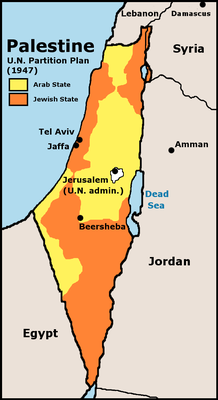
Looking at the map of the original UN division plan, the „Arab state“ (commonly understood as the Palestinian state) would indeed reach from the (Mediterraen) sea to the (Jordan) river:
https://www.ieg-ego.eu/illustrationen/entiwcklung-des-zionismus-bilderordner/karte-un-teilungsplan-fuer-palestina-img/@@images/107a5790-2927-4043-8a92-4d7077016da7.png
The slogan, however does not state that the entire east coast of the Mediterrean and the entire west bank of the Jordan river shall belong to Palestine and completely exclude Israel.
Aside rejecting the allegedly genocidal meaning and intent of the slogan, two Jewish Professors have another interesting take:
„if we accept that a Palestinian calling for the ‘liberation of Palestine from the Jordan River to the Mediterranean sea’ wants to expel the Jews from Israel, then fairness requires that the opposite should also hold true: that anyone who has ever supported Greater Israel – from the poet Nathan Alterman (one of the most important Israeli poets, who identified politically with the Labour party) and the signatories of the Greater Israel Manifesto in 1967 to the current government and the public that supported it at the ballot box – actually supports the annihilation or expulsion of the Palestinians.
But this too would be inaccurate…“
The authors argue that both „from the river to the sea“ and „Palestine will be free“ have a variety of meanings and a wide range of interpretations, e.g. „Even if a significant portion of Palestinians are willing in principle to agree on a compromise that would mean the establishment of a sovereign Palestinian state in the West Bank, East Jerusalem and the Gaza Strip, which together constitute about 22% of Mandatory Palestine, they still regard all of Palestine as their homeland.“
They also refer to the fact that „it should be mentioned that the 2017 addendum to the [1988 Hamas] charter (par. 20) accepts the idea of a Palestinian state along the 4 June 1967 borders (i.e. the borders prior to the 1967 war) as a ‘formula of national consensus’.“
Another Middle Eastern scholar writes „the majority of Palestinians who use this phrase do so because they believe that, in 10 short words, it sums up their personal ties, their national rights and their vision for the land they call Palestine.“
The phrase „also seeks to reaffirm Palestinians’ national rights over their homeland and a desire for a unified Palestine to form the basis of an independent state.“
The Palestinian-American writer Yousef Munayyer says the phrase is „merely a way to express a desire for a state in which “Palestinians can live in their homeland as free and equal citizens, neither dominated by others nor dominating them”.“
The German journalist Kristin Helberg legitimately refers to two less biased and less violent interpretations of the slogan: „Either it is about bringing an end to the occupation of the territories that have been occupied since 1967, and establishing a Palestinian state alongside Israel. Or the aim is a one-state solution, which affords equal rights to all residents. In light of the seven million Jews and seven million non-Jews living in the territory, this could, in the medium term, turn Israel from a Jewish state into a state for all citizens. In neither case is anyone saying that Jews should be expelled or even murdered. „
 radioyaran